Tarmac Resurfacing
Project Overview
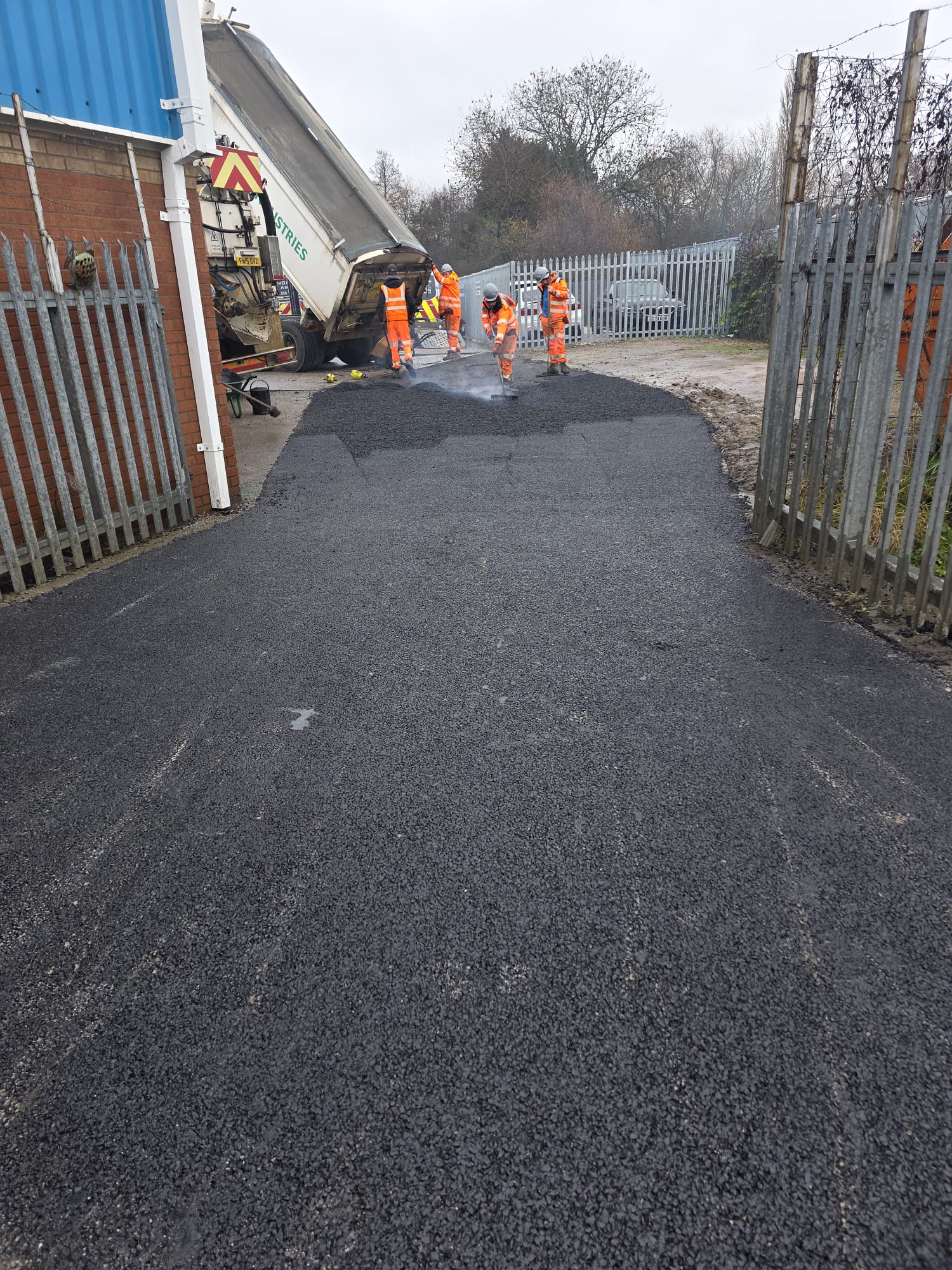
Civils and Environmental Ltd were commissioned to undertake tarmac resurfacing and trench reinstatement works within an operational industrial yard. The scope focused on planing out and relaying previously installed road trenches, restoring structural integrity and providing a long-lasting, smooth, traffic-ready surface.
The works were designed to reinstate the yard following underground service works, ensuring the surface could withstand HGV movements, plant traffic, and daily operational loads.
Initial Site Inspection & Assessment
Following a detailed site inspection of the yard, it was identified that:
Existing reinstated trenches required upgrading
Surface levels needed correction
The finished surface required improved durability
Proper bonding between existing and new asphalt was essential
The reinstatement was specified to a depth of approximately 80mm, ensuring adequate structural strength and longevity in a heavy-duty environment.
Phase 1: Planing & Surface Preparation
Mechanical Planing (Approx. 80mm Depth)
The first stage involved mechanical planing (milling) of the trench sections to remove the existing surfacing material to the required depth.
This process:
✔ Removes compromised or uneven material
✔ Creates clean vertical edges for bonding
✔ Ensures consistent reinstatement depth
✔ Prevents reflective cracking
All arising materials were removed from site and disposed of via licensed waste channels or recycled where appropriate.
Phase 2: Binder Course Installation
60mm AC20 Binder Course
Following preparation, a 60mm layer of AC20 dense binder course asphalt was laid.
AC20 binder course is designed to:
Provide structural strength
Distribute vehicle loads
Act as the primary load-bearing asphalt layer
Resist deformation under heavy traffic
The material was machine-laid and compacted using vibrating rollers to achieve correct density and compaction values in line with industry best practice.
Phase 3: Surface Preparation & Bonding
Thorough Mechanical Sweep
Before laying the surface course, the area was:
Thoroughly brushed and mechanically swept
Cleared of debris, dust, and loose aggregate
Inspected to ensure optimal adhesion conditions
Proper cleaning is critical to prevent delamination between asphalt layers.
Application of K1-40 Tack Coat
A K1-40 bitumen emulsion tack coat was evenly applied across the binder layer.
Tack coating ensures:
✔ Strong interlayer bonding
✔ Reduced risk of slippage or separation
✔ Long-term durability of the asphalt system
✔ Enhanced structural performance
This stage is essential for maintaining pavement integrity under heavy traffic conditions.
Phase 4: Surface Course Installation
40mm SMA10 Surface Course
The final running surface consisted of 40mm Stone Mastic Asphalt (SMA10).
SMA10 is selected for:
High durability in commercial and industrial yards
Excellent rut resistance
Improved skid resistance
Smooth, uniform finish
Enhanced long-term wear performance
The material was laid to level tolerance and compacted to achieve a consistent finish, ensuring proper surface water runoff and safe vehicle operation.
Quality Assurance & Finishing
Upon completion:
All reinstated areas were checked for level consistency
Edges were sealed where required
Surface tolerances were visually and physically inspected
Site left clean and operationally ready
The finished surface provides a durable, heavy-duty reinstatement designed to perform under frequent industrial traffic.
Outcome & Client Benefits
✔ Structural reinstatement of road trenches
✔ Improved surface durability and lifespan
✔ High-performance AC20 binder and SMA10 wearing course
✔ Strong interlayer adhesion via K1-40 tack coat
✔ Smooth, compliant and professional yard finish
✔ Reduced risk of water ingress and future failure