Cesspool Tank Install
Project Background
Our client had recently acquired a new commercial site that required updated wastewater storage infrastructure to support additional buildings and changes in site use. As part of this expansion the need for a replacement cesspool tank to safely store sewage and wastewater generated on site was identified.
Initial Site Investigation & Planning
Before installation, our team carried out a comprehensive site investigation to assess ground conditions, site access, and existing drainage connections. This included:
Surveying underground utilities to identify any potential conflicts with new excavation works.
Checking structural load limits, to confirm that access for machinery such as excavators and tank-lifting rigs was suitable.
Compliance checks with local building regulations and planning requirements for cesspool tanks, including minimum capacity standards typically expected for domestic and commercial applications.
This planning phase ensures installations are safe, compliant, and fit for purpose, reducing risk of future issues.
Excavation & Groundworks
Once planning was complete, the team mobilised heavy plant and excavation crews to prepare the location for the new tank:
Excavate a correctly sized pit large enough to house the tank’s footprint with sufficient clearance for backfill and any concrete support if required.
De-water the excavation, where necessary, to create a stable and dry working area — especially if groundwater was present.
Prepare a level base, often including a concrete slab or compacted hardcore base, to provide stable support and prevent future settlement.
These steps are critical in ensuring the cesspool tank is installed on a solid, long-lasting foundation.
Tank Delivery & Installation
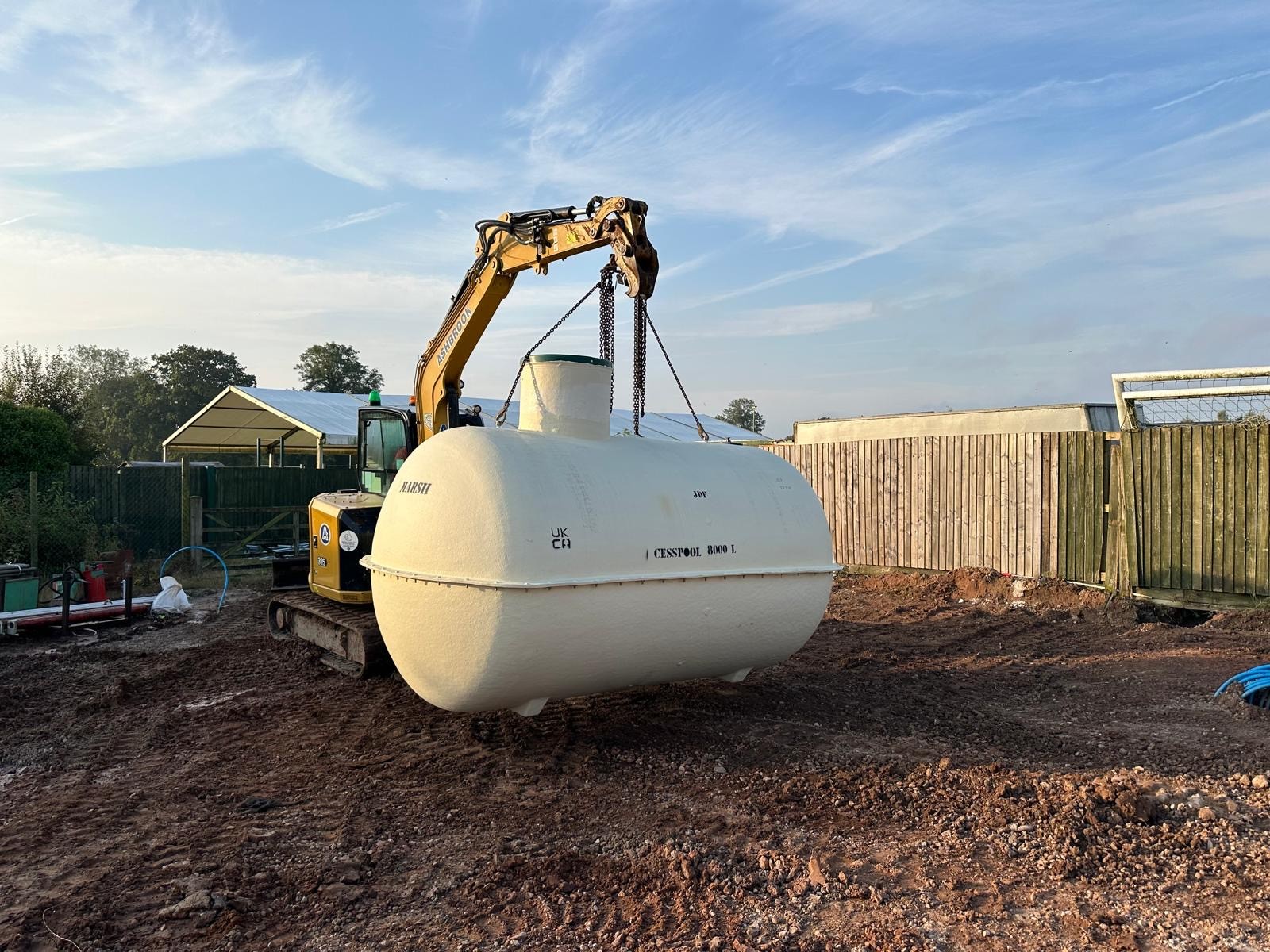
In this project, an 8000-litre cesspool tank was delivered and installed in accordance with the agreed design. The installation process included:
Positioning the tank in the excavation using lifting equipment, ensuring correct alignment and orientation to match incoming and outgoing drainage connections.
Integrating a high-level alarm system, which alerts the site manager or maintenance team when the tank reaches capacity — an important safety and compliance feature.
Connecting all necessary drainage lines from the new site buildings into the cesspool so that wastewater flows correctly into the storage tank.
Modern cesspool tanks are designed to be watertight and durable, typically manufactured from materials such as reinforced concrete, polyethylene, or glass-reinforced plastic (GRP), and must be installed to comply with building regulations.
Backfill & Site Reinstatement
After the tank was correctly positioned and connected, the excavation was backfilled using appropriate materials:
Controlled backfill around the tank walls and base to prevent movement.
Concrete surrounds or hard core, where required, to protect the tank from ground pressures and future loads.
Final site reinstatement to restore ground surfaces, followed by connection to the access point for future emptying and maintenance.
This ensures the site is left safe, tidy, and ready for operation.
Post-Installation Testing & Handover
Before completion of the contract, we carried out quality checks including:
Leak testing to ensure all connections were sealed and that the cesspool was watertight.
Alarm system commissioning to ensure the high-level alarm functioned correctly.
Operational handover with the client, including explanation of maintenance requirements such as regular emptying by a licensed desludging contractor — a legal obligation for cesspools in the UK.
Outcome & Client Benefits
The completed installation provided our client with:
✔ A fully functioning cesspool tank sized appropriately for site requirements.
✔ Connected drainage infrastructure to all new buildings on the site.
✔ High-level alarm for early warning of capacity limits.
✔ Compliance with applicable building standards and long-term site usability.
This project demonstrates our ability to deliver complex drainage infrastructure installations with minimal disruption and a focus on regulatory compliance and durability.
Why Professional Cesspool Installation Matters
A cesspool is a sealed underground wastewater storage tank that requires careful design and installation to ensure it functions safely over its lifespan. Unlike septic tanks or treatment plants that may discharge treated effluent, a cesspool simply stores wastewater until it is emptied — which must be conducted regularly by a licensed waste carrier. Proper installation and maintenance minimise environmental risk, prevent sewage leaks, and ensure compliance with local building regulations.